Welcome to Kim's School of Tae Kwon Do, LLC
View Larger Map
What is: Tae Kwon Do? Karate? Kung Fu? Judo?
Tae Kwon Do top
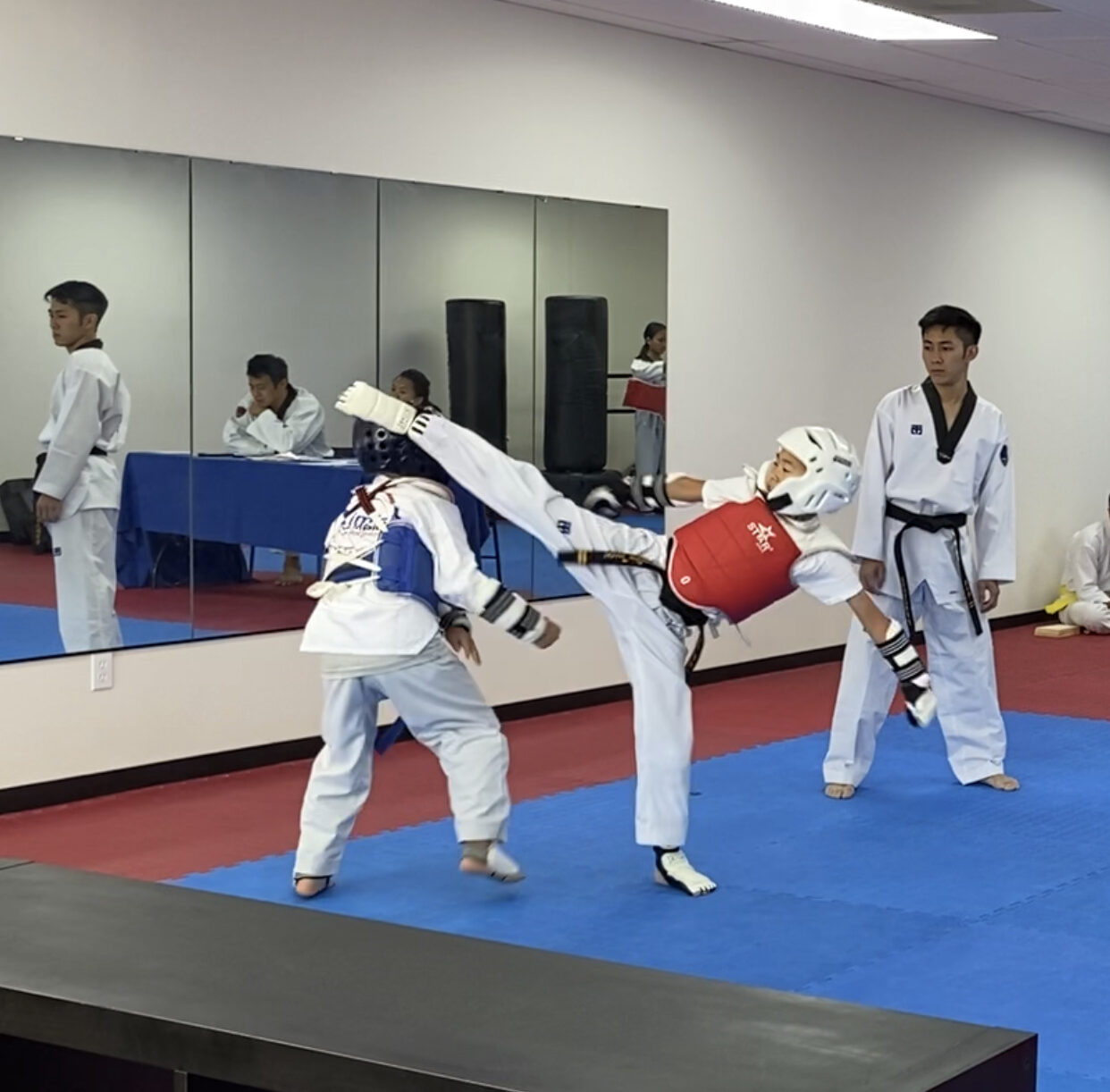
Tae Kwon Do is a traditional Martial Art form from Korea, and is both the national sport of South Korea and a recognized Olympic sport. The name Tae Kwon Do loosely translates from Korean as the way of the foot and the fist.
By placing emphases on kicking techniques Tae Kwon Do is able to distinguish itself from other martial arts. In doing so an advantage of increased strength and range is gained. However, Tae Kwon Do still incorporates many hand and punching techniques.
Tae Kwon Do traces its origins to a combination of the martial art fighting styles of three rival Korean kingdoms. This type of combat was taught to young men of the time to develop strength, speed, and survival skills. Later, these techniques were refined and taught along side academics and liberal arts to groups chosen as elite warriors.
Even while the Japanese forces occupied Korea and the traditional Korean martial art was banned there where still citizens practicing through underground teachings and folk customs. This more traditional style later became known as Tae Kwon Do. After the Korean War, Tae Kwon Do regained prominence and received its first codification under the name Tae Kwon Do. In 1988 Tae Kwon Do became recognized as an Olympic demonstration sport at the games in Seoul, Korea, and in the 2000 Sydney games Tae Kwon Do sparring became one of only two Martial Arts (Judo is the other) to be chosen as medal competition Olympic sports.
As is true with most Martial Arts being practiced in the United States, the combative nature is present, but there is also focus on strength, fitness, discipline, and mental focus.
Karate top
Karate is commonly thought of as the traditional Martial Art of Japan. The name Karate translates roughly to empty hand.
Karate, as it is known today, has many varieties. The origins of this Martial Art come largely from schools in Japan and Okinawa, and the relationship between both those regions and those schools has been complex. Karate also shows clear influences from other Martial Arts such as Chinese Kung Fu.
The styles of Karate have been changed, and continue to change up through the present time, by various practitioners and schools. Because of these changes along with the divergent way in which Karate originated, Karate today exists in many distinct forms.
As is true with most Martial Arts being practiced in the United States, the combative nature is present, but there is also focus on strength, fitness, discipline, and mental focus.
Kung Fu top
Kung Fu as it is used in an American vocabulary refers very broadly to Chinese Martial Arts. This can be misleading, as the history of Chinese Martial Arts traditionally dates back to almost 2700 B.C., and therefore this common ancestor has produced a wide variety of Martial Arts descendants. Within the umbrella of the very broad term Kung Fu, many specific varieties flourish. These differing Martial Arts generally can be divided into two main schools, those originating in Southern China and those originating in Northern China. Southern Chinese Kung Fu is known for heavy stances and hand techniques, while Northern Chinese Kung Fu is known for high jumps and fluid movements.
Kung Fu is often associated with the Shaolin Monks. These monks have incorporated Kung Fu into their lives to the point where it is often seen in their art, literature, and philosophy. It is not uncommon for groups of Shaolin Monks to travel on exhibition tours that showcase their Martial Arts skill.
Kung Fu, and Chinese Martial Arts in general, gained in popularity and accessibility in the mid twentieth century after the Japanese invasion and Chinese Civil War. The Martial Arts were seen as a way of instilling national pride and instructors were encouraged to practice their Martial Arts openly.
Kung Fu was demonstrated at the eleventh Olympic Games in Berlin which brought worldwide attention not only to Kung Fu, but to all Martial Arts.
As is true with most Martial Arts being practiced in the United States, the combative nature is present, but there is also focus on strength, fitness, discipline, and mental focus.
Judo top
Judo is a very modern version of the Japanese Martial Art Jujitsu. The name Judo means the gentle way. This offshoot from the Martial Art Jujitsu was created and founded at the beginning of the twentieth century by a Jujitsu student who weighed less than a hundred pounds. Because of this physical limitation, Judo was created to use a stronger opponents weight and strength against them.
Judo stresses pushes, pulls, joint locks, throws and choking to defeat an opponent. There are two phases of Judo, including the standing phase, and the ground phase.
Although created very recently, Judo became an Olympic Sport at the 1964 Tokyo Games.
As is true with most Martial Arts being practiced in the United States, the combative nature is present, but there is also focus on strength, fitness, discipline, and mental focus.